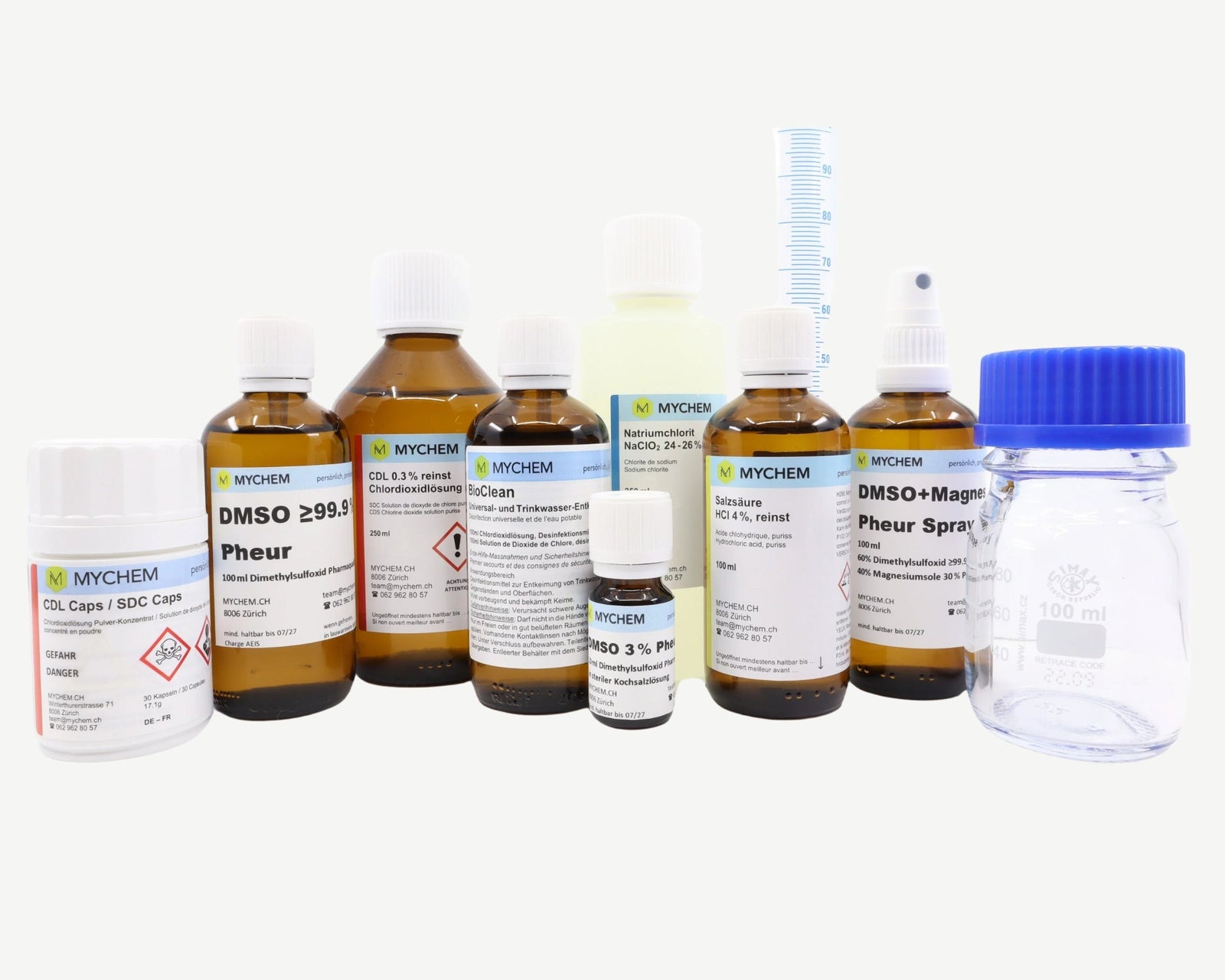
Two terms are often used in connection with chlorine dioxide: CDS and MMS. Many people therefore wonder what exactly the difference is. Search queries such as "CDS vs MMS", "Difference CDS MMS" or "MMS or CDS" are among the most frequently asked questions on this topic.
In this article, we explain simply and objectively how CDS (chlorine dioxide solution) and MMS.
What is CDS?
CDS stands for chlorine dioxide solution. This is chlorine dioxide gas (ClO₂) dissolved in water.
Chlorine dioxide is a yellowish-coloured gas with strong oxidizing properties. As it is relatively unstable as a gas, it is often dissolved directly in water. This produces a ready-to-use solution with a defined concentration.
Typical properties of CDS are:
- slightly yellowish color
- Characteristic odor
- defined concentration (e.g. 3000 ppm)
- Ready-to-use solution
With CDS the chlorine dioxide is already completely dissolved in the water.
What is MMS?
MMS is a term for a sodium chlorite solution that is activated with an acid.
Chlorine dioxide is only produced during this reaction. This means that with MMS, the chlorine dioxide is not present from the outset, but is only formed when the components are mixed.
MMS typically consists of two components:
1. sodium chlorite solution
2. activator (usually an acid)
When mixed together, sodium chlorite reacts with the acid to form chlorine dioxide.
The most important difference between CDS and MMS
The fundamental difference is simple:
CDS already contains dissolved chlorine dioxide.
MMS only produces chlorine dioxide through a chemical reaction.
While CDS In other words, while MMS is a ready-made solution, chlorine dioxide is only produced during activation.
Differences in production
Production of CDS
With CDS chlorine dioxide gas is produced and then introduced into water. This produces a defined chlorine dioxide solution.
The purity can vary depending on the manufacturing process.
One method is to produce pure chlorine dioxide gas and inject it directly into water. This means that fewer by-products enter the solution.
Production of MMS
With MMS, a sodium chlorite solution is mixed with an acid.
This reaction produces chlorine dioxide. However, other reaction products can also be formed at the same time.
The chlorine dioxide is therefore only formed at the moment of activation.
Difference in the composition
The composition also differs.
CDS
- Water
- Dissolved chlorine dioxide
- very pure, e.g. 20-100 µS/cm (microsiemens per cm) depending on the supplier or manufacturing process extremely higher.
MMS
- Sodium chlorite
- Acid (activator), e.g. hydrochloric or citric acid
- Impurities in the reaction chemicals (mostly heavy metals)
- Reaction products of the chemical reaction (e.g. chlorites, chlorates .....)
- Highly contaminated, e.g. 1000-5000 µS/cm (microsiemens per cm)
Concentration of CDS
A frequently used concentration is:
CDS 3000 ppm
This corresponds roughly to:
0.3 % chlorine dioxide in water
The concentration may vary depending on the manufacturer.
Practical differences
In practical use, there are some differences between the two variants.
CDS
- Finished solution
- Defined concentration
- No activation necessary
MMS
- two components
- Activation required
- Chlorine dioxide is only formed during the reaction
Conclusion
The difference between CDS and MMS lies mainly in the production, quality of the raw chemicals and composition.
• CDS (chlorine dioxide solution) is a ready-to-use solution in which chlorine dioxide is already dissolved in water.
• MMS consists of a sodium chlorite solution in which chlorine dioxide is only produced by a chemical reaction with an activator (acid).
Anyone dealing with chlorine dioxide should therefore pay close attention to what type of product is meant and how it is manufactured.


 from
CHF 19.00
from
CHF 19.00 from
CHF 21.00
from
CHF 21.00
 CHF 12.00
 CHF 50.00