Newly manufactured with the gas injection method
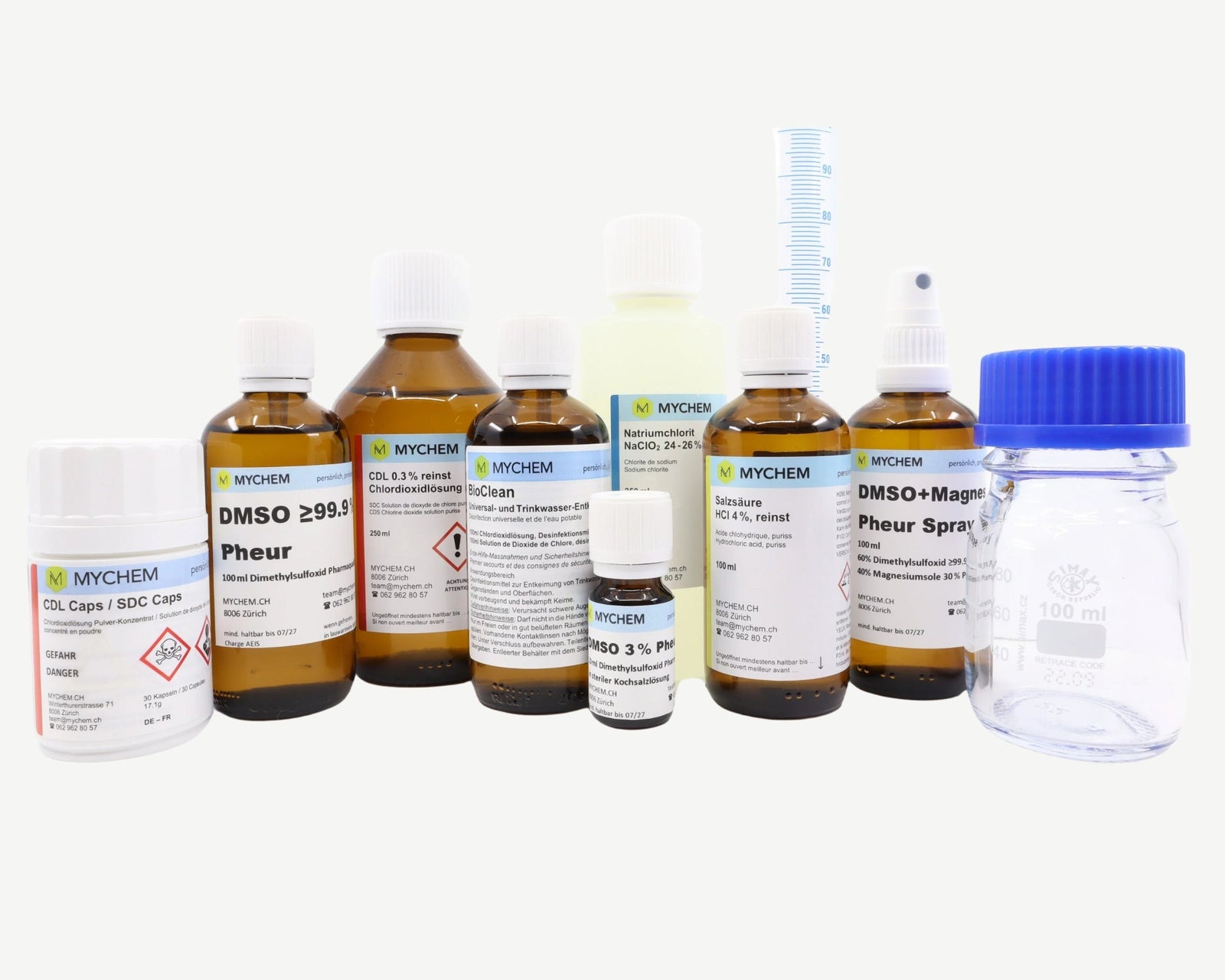
Our Mychem chlorine dioxide solution becomes new with the Gas injection procedureproduced. The method for producing CDS for the best quality and purity.
Results of our first batch from 08.03.2026 (the values may vary slightly from batch to batch):
- Concentration: 3010 ppm
- Conductance: 24 µS/cm
- pH value: pH 6.2
Why water quality is the basis of every high-quality solution
Water is the most commonly used solvent and diluent in chemical and technical processes. But normal tap water contains:
- Dissolved salts
- Minerals
- organic trace substances
- Micropollutants
These components influence reaction behavior, stability and measuring accuracy.
The purer the source water, the:
- the target concentration remains more stable
- undesirable side reactions are lower
- lower is the conductivity
- the end result is more reproducible
High-quality solutions therefore always start with controlled water treatment.
Produce ultrapure water: The 3-step purification process
A multi-stage Water treatment significantly improves the chemical base. Typical steps are
1. demineralization (demineralization)
Almost all dissolved ions are removed during demineralization. These include calcium, magnesium, sodium and chloride, for example.
Advantage: Very low conductivity and minimal salt load.
2. ultra-fine filtration (e.g. 3 µm)
Mechanical filters remove particles, suspended matter and microscopic residues.
Advantage: Clear solution without solid impurities.
3. activated carbon cleaning
Activated carbon binds organic substances, odors and many chemical trace compounds.
Advantage: Reduced organic load and improved chemical stability.
ppm - The meaning of the concentration specification
ppm (parts per million) means "parts per million".
Example:
3000 ppm corresponds to 0.3 % active substance content in a solution.
Important to understand:
ppm exclusively describes the Concentration - not the purity. A solution can have a high concentration but still be impaired by impurities in the source water. Therefore, ppm values should always be considered in conjunction with other quality parameters.
pH value simply explained
The pH value indicates how acidic or alkaline a solution is.
- pH 7 → neutral
- pH < 7 → acidic
- pH > 7 → basic
The pH value influences:
- Chemical reactivity (ability of a substance to undergo chemical reactions)
- Stability
- Material compatibility
- Shelf life
Even small deviations can cause considerable differences in sensitive solutions.
Conductivity (µS/cm) - A key indicator for purity
Electrical conductivity measures the amount of dissolved ions in a liquid.
Unit: Microsiemens per centimeter (µS/cm)
For comparison:
- Tap water: approx. 200-800 µS/cm
- High purity water: below 30 µS/cm
The lower the conductance, the lower the ion load.
Low conductivity is therefore a strong indication of:
- Effective demineralization
- Clean process control
- Minimized foreign ions
Why all quality parameters should be considered together
A single measured value is not sufficient.
Only the combination of:
- Concentration (ppm)
- pH value
- Conductivity (µS/cm)
- documented water treatment
provides a complete picture of the quality of a solution.
If you want to achieve reproducible results, you must therefore systematically monitor all parameters.
Conclusion: Quality starts with water
Whether in laboratories, technology or industrial applications - the basis of high-quality solutions is controlled water purity.
ppm, pH value and conductivity are not abstract laboratory figures, but measurable quality indicators.
Those who understand and consistently optimize these values set new standards in process reliability and product quality.


 from
CHF 19.00
from
CHF 19.00 from
CHF 21.00
from
CHF 21.00
 CHF 12.00
 CHF 50.00