Why is my self-made CDS only pale yellow?
Chlorine dioxide solution is often produced by private individuals using a reaction process.
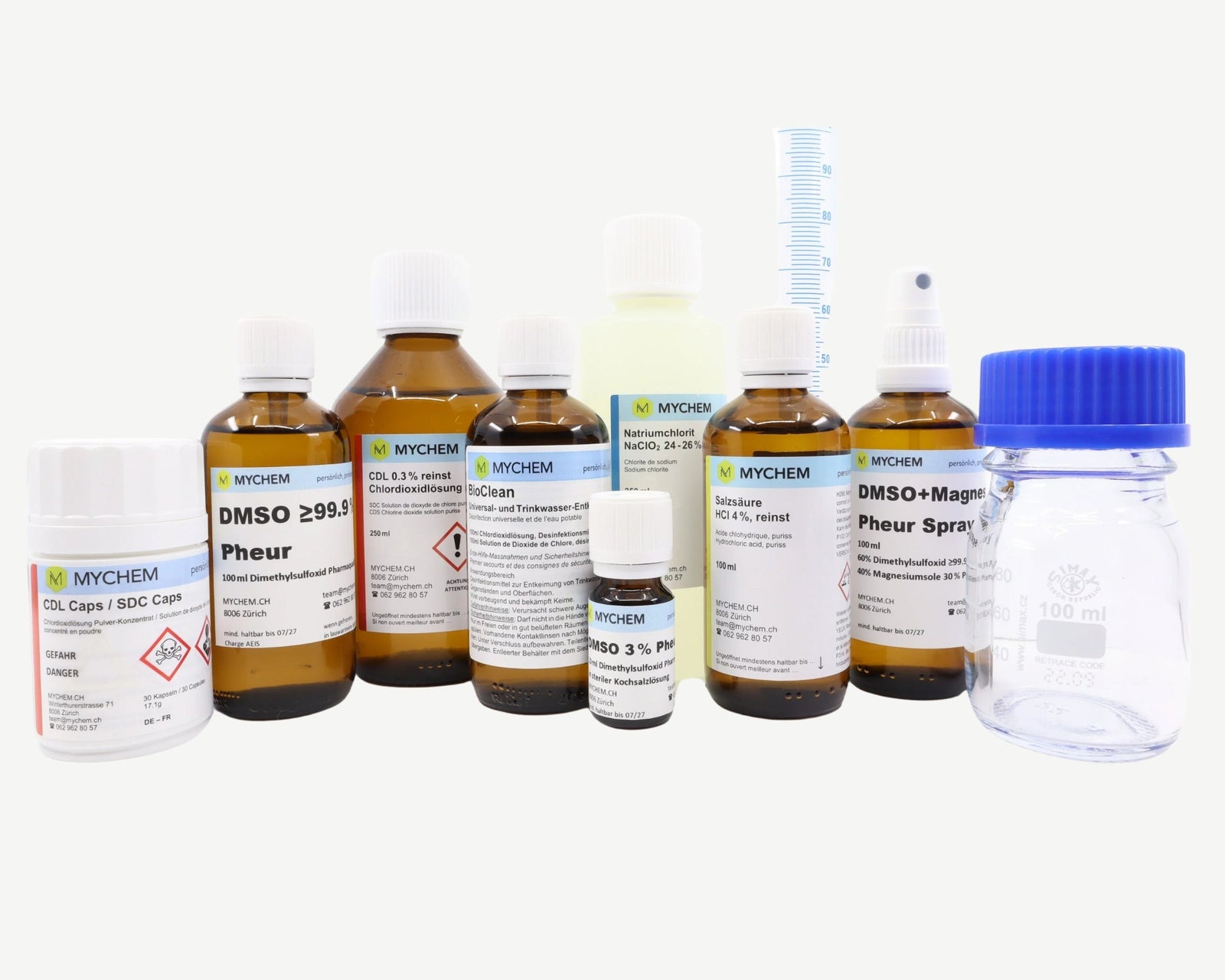
Sodium chlorite solution 25% and an acid are used for this purpose.
Citric acid used to be known as an acid. Today, hydrochloric acid 4% has become commonplace.
There are various methods for this. Examples:
"Portion method"
For example, 3 drops each of sodium chlorite solution 25% and hydrochloric acid 4% are mixed in a glass. These then react with each other for a few seconds. As soon as the color of the concentrate has turned dark yellow or brownish, water is added. This solution is then used.
"Cucumber jar method"
A shot glass is placed in a pickle jar which already contains a certain amount of water. The water surrounds the shot glass.
A certain amount of sodium chlorite solution 25% and hydrochloric acid 4% is then added to the shot glass and the pickle jar is tightly sealed. The two chemicals react together and release chlorine dioxide gas, which is absorbed by the surrounding water.
Why does my chemical mixture only turn slightly yellow?
The reason is quickly explained: you will probably die of "sodium chlorite puriss" instead of the conventional "technical" solution.
Substances which contain the suffix "puriss" carry significantly lower concentrations of foreign substances than "normal technical" substances. Technical substances contain foreign substances. These are mostly heavy metals:
- Arsenic (As)
- Lead (Pb)
- Mercury (Hg)
- Cadmium (Cd)
- Chromium (Cr)
- Nickel (Ni)
- Antimony (Sb)
Such substances can also react with hydrochloric acid and thus intensify the yellow color, which can affect the concentrate and possibly your CDS contaminate.
In other words:
If you use sodium chlorite solution puriss use MUST the yellow tone will be weaker!
We are happy to help with any questions: team@mychem.ch


 from
CHF 19.00
from
CHF 19.00 from
CHF 21.00
from
CHF 21.00
 CHF 12.00
 CHF 50.00