

















CDS-products often differ significantly in their actual concentration - even if they are labeled similarly.
👉 In this article you will learn:
- what 3000 ppm and 1500 ppm actually mean
- what differences occur in practice
- What you should look out for in terms of quality and comparison
In this comparison, we use real measured values to show what is important for CDS really matters.
What does ppm mean for CDS?
The abbreviation "ppm" stands for "parts per million" and describes the concentration of chlorine dioxide in a solution.
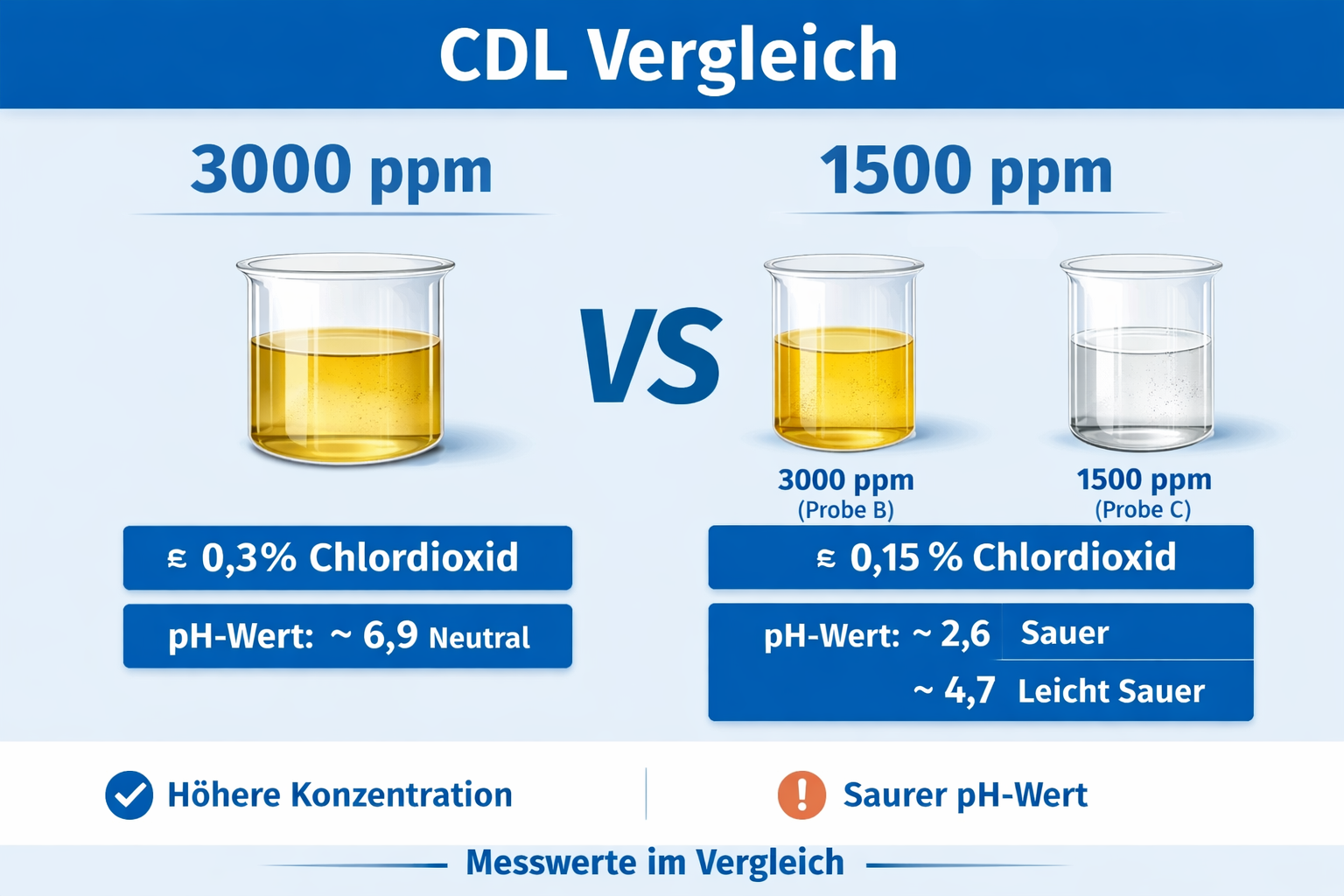
- 3000 ppm = 0.3 % chlorine dioxide
- 1500 ppm = 0.15 % chlorine dioxide
A solution with 3000 ppm therefore contains approximately twice the amount of dissolved chlorine dioxide.
Why concentration is crucial
The concentration determines how much chlorine dioxide is actually present in the solution.
Products with a lower ppm value contain correspondingly less active ingredient - even if they look or are described in a similar way.
What role does the pH value play?
In addition to the concentration, the pH value is also an important parameter.
- pH 7 = neutral
- pH below 4 = clearly acidic
Differences in the pH value may indicate different manufacturing processes or compositions.
Practical comparison: measured values at a glance
In a comparative test, several CDS-samples were analyzed under identical conditions:
- Sample A: approx. 3000 ppm / pH ~6.9
- Sample B: approx. 1500 ppm / pH ~2.6
- Sample C: approx. 1500 ppm / pH ~4.7
The results clearly show that both concentration and pH value can vary greatly.
Can you recognize quality by color or smell?
Chlorine dioxide is a yellowish gas that is dissolved in water.
Color or odor can provide clues, but are not reliable measurement methods.
An exact assessment is only possible through analysis.
What should you look out for?
- Clear indication of the concentration (ppm)
- Information on the pH value
- Transparent measured values
- Comprehensible quality specifications
👉 Basics: What is CDS?
Conclusion
CDS is not the same as CDS - The decisive factors are verified values and clear information.
Those who pay attention to defined concentration and comprehensible quality can compare products better and classify them with confidence.
👉 You can find the complete comparison test here:
CDS View comparison test


