


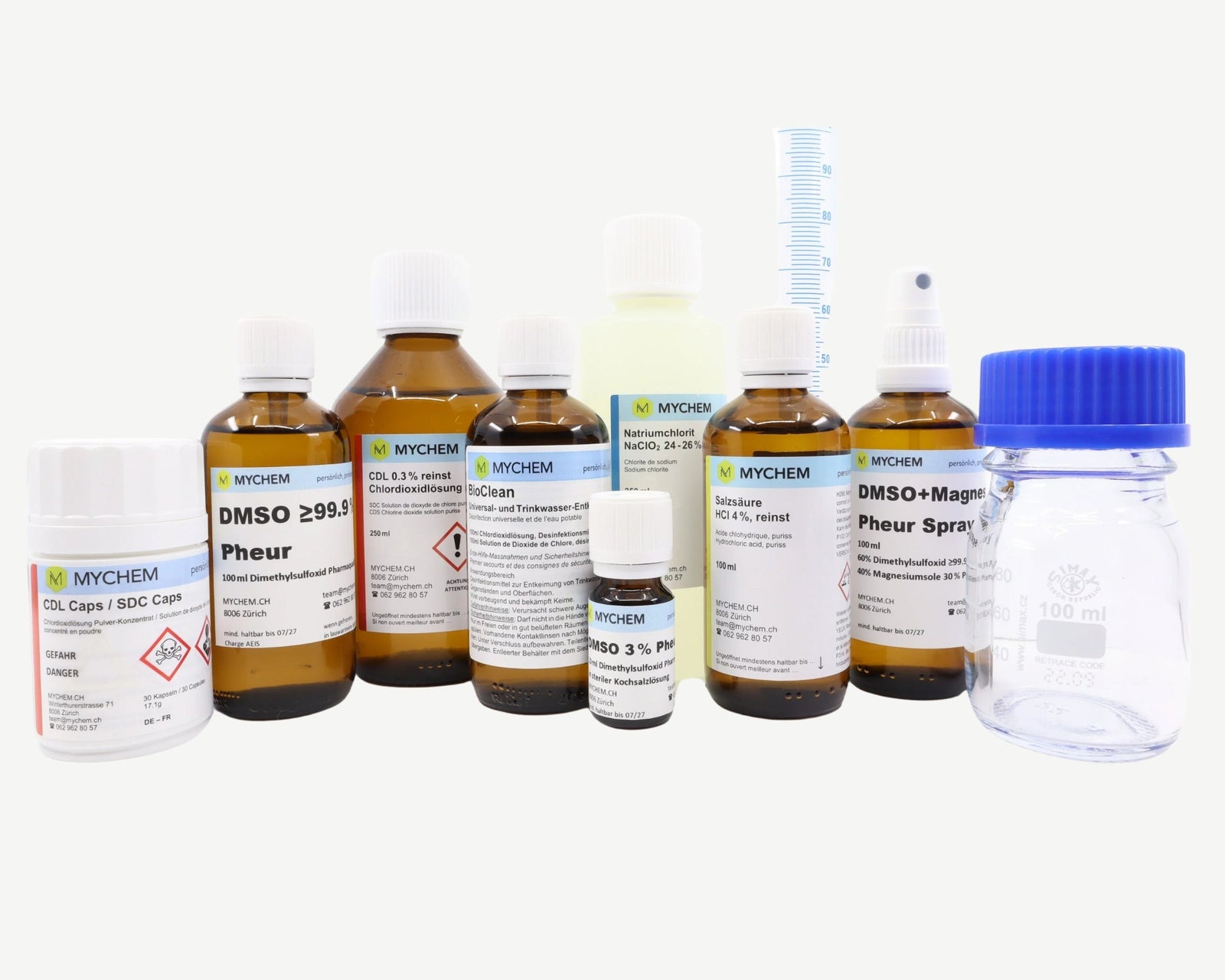















What is CDS? CDS (chlorine dioxide solution) is an aqueous solution of chlorine dioxide (ClO₂) with a defined concentration - usually 3000 ppm (0.3 %).
Anyone looking for "What is CDS?" usually wants to understand quickly, what CDS exactly what 3000 ppm means, how the solution can be classified and what to look out for in terms of quality and labeling.
In this article you will learn:
- what CDS is accurate
- what 3000 ppm means
- like CDS is produced
- What to look out for in terms of quality, shelf life and labeling
🇨🇭 Swiss quality: Our CDS 0.3 % is produced under controlled conditions and analytically tested. Concentration, purity and traceable labeling are important characteristics of a high-quality solution.
👉 Freshness CDS in tested Swiss quality:
💧 CDS 3000 ppm - View Swiss quality
What does CDS?
CDS stands for Chlorine dioxide solution. This is water in which chlorine dioxide gas is dissolved.
In contrast to activated mixing systems, the active ingredient is already present here in dissolved form. This means that the solution is clearly defined and can be classified directly.
What is chlorine dioxide?
Chlorine dioxide (ClO₂) is a chemical substance with strong oxidizing properties. It has been used for many years in areas where hygiene and water quality play an important role.
In CDS Chlorine dioxide is present as a dissolved gas in water.
What does 3000 ppm mean?
The indication 3000 ppm corresponds to a concentration of 0.3 % chlorine dioxide.
A clearly stated concentration creates comparability and is an important indication of the quality of a solution.
Why is concentration important?
- Comparability of products
- Clear classification of quality
- Traceability of the information
- Better assessment of the solution
How to CDS produced?
Chlorine dioxide is produced and then introduced into water. The production process is decisive for the quality.
Differences in production, purity and process control can significantly influence the quality of a solution.
How do you recognize high-quality CDS?
- Clear indication of concentration (e.g. 3000 ppm)
- clean labeling
- Suitable packaging
- Transparent manufacturer information
- Controlled production
How long is CDS durable?
CDS does not have an unlimited shelf life. The stability depends on light, temperature and how the bottle is handled, among other things.
What is CDS used?
CDS is used in various areas, especially where hygiene, water quality and traceable concentration are important.
Is CDS equals MMS?
No. CDS is a ready-made solution with a defined concentration, while MMS is only activated by mixing.
Frequently asked questions about CDS
What is CDS?
CDS (chlorine dioxide solution) is an aqueous solution of chlorine dioxide (ClO₂) with a defined concentration - usually 3000 ppm (0.3 %).
What does 3000 ppm mean?
3000 ppm corresponds to a concentration of 0.3 % chlorine dioxide in water.
What is CDS used?
CDS is mainly used where hygiene, water quality and a clearly defined concentration are important.
How do you recognize high-quality CDS?
Important criteria are a clear indication of concentration, clear labeling, suitable packaging and controlled production.
🔎 Which CDS-variant suit you?
Ready for immediate use, clear concentration, easy to use.
👉 CDS view directly
🔎 CDS Knowledge at a glance
Conclusion
CDS is a ready-to-use chlorine dioxide solution with a defined concentration.
The decisive factors for quality are concentration, production, packaging, shelf life and transparent labeling.
💧 CDS 3000 ppm - discover proven Swiss quality
💧 BioClean - clean water on the go
Registered chlorine dioxide solution for simple water treatment - ideal for outdoor and traveling.
👉 View BioClean


